


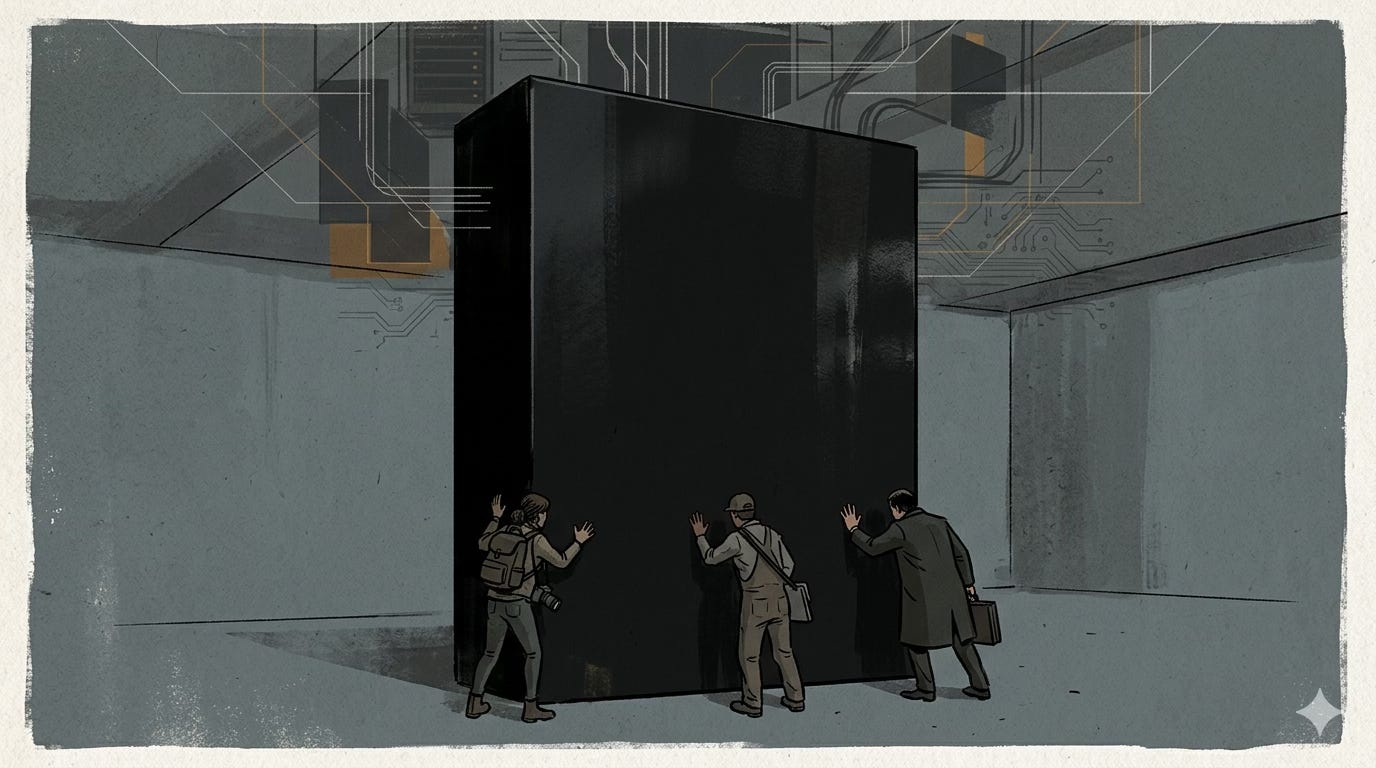
The email arrived on a Tuesday morning. The subject line read: “New coverage issue detected in [site].” I had submitted a sitemap to Google Search Console weeks earlier, watched the pages get crawled, and assumed things were working. They weren’t. Google’s system had found a reason my pages couldn’t be indexed. The email existed to tell me that.
It did not tell me what the reason was.
I spent an hour in Search Console. I read the documentation. I searched the forums, where I found dozens of other people asking the same question, getting the same silence. The notification system knew why. It had recorded the reason, acted on it, logged it somewhere in Google’s infrastructure. What it hadn’t done was tell me.
So I opened Claude and asked two questions. Within a minute, I had the diagnosis: a domain configuration conflict, www versus non-www, the kind of mismatch that indexing systems catch immediately and that any halfway-decent error message would have named outright. Google’s system knew this. Google’s notification didn’t say it. I needed an AI to understand what the dominant platform wouldn’t explain.
On August 29, 2025, Linus Sebastian, founder of Linus Tech Tips and one of the most-watched technology creators on the platform, described his channel as being on a “struggle bus.” Viewership had fallen to roughly three-quarters of its normal level. He was careful about how he framed it. “I’m not going to be one of those guys, that’s all, ‘Algorithm!’” He reached out to YouTube directly. “It does seem,” he said, “like there has been a very dramatic shift.”
YouTube did not explain what shifted.
He had 16 million subscribers, nearly 17 years of data, and direct access to the platform’s support channels. He got nothing a smaller creator wouldn’t have gotten. The platform knew what changed. Telling him wasn’t a priority.
Both platforms have engineering teams that could ship better notifications tomorrow. Google’s indexing system already knows the reason it won’t index a page. It recorded the reason before it sent the email. The gap between what the system knows and what it tells you is not a technical limitation. It’s a resource allocation decision made in an organization that faces no competitive pressure to allocate differently.
Platforms don’t become opaque when they fail. They become opaque when they win.
Two-sided market economics has a formal literature behind it: Geoffrey Parker, Marshall Van Alstyne, and Jean Tirole, who won the Nobel for related work in 2014. The core mechanic is the same across all of it: platforms subsidize the side that attracts the other. Early YouTube needed creators to attract viewers. Without creators, no viewers. Without viewers, no advertisers. Transparency was the subsidy: analytics, documentation, creator support. That was what made the supply side show up. The platform courted creators because it had no choice. The moment dominance arrives, that dependency inverts. The platform no longer needs to acquire the supply side. The supply side needs the platform’s audience. The economic logic that produced maximal transparency produces minimal transparency once competitive pressure disappears.
What replaces transparency is structural. Google and YouTube don’t employ engineers to build bad notifications. The bad notification is what you get when nobody has a reason to build a better one. The platform’s lawyers don’t want specificity. Specificity creates accountability, and accountability creates litigation. The product team has higher-priority work. The creator support team is understaffed because the platform’s revenue doesn’t depend on creator satisfaction. Nobody made a decision to be opaque. The organization made ten thousand smaller decisions, each locally rational, and opacity was the aggregate.
What traps creators and businesses inside this design is not a single wall. It’s the accumulated weight of good decisions. Your site is built around Google’s sitemap format because that’s what indexing requires. Linus’s workflow runs on YouTube’s analytics because those are the only analytics that matter for his business. His subscribers exist on YouTube’s servers. His 17 years of content exist on YouTube’s servers. Migrating doesn’t mean switching platforms. It means starting over with an audience that can’t follow.
For businesses on cloud infrastructure, the lock-in is the same shape at larger scale. A company that chose AWS for its economics in 2015 has spent a decade building integrations against AWS endpoints, training its engineers on AWS tooling, architecting its systems around AWS services. Each decision was defensible. Together, they’re a switching cost that makes “just move” approximately equivalent to “rebuild your company.” The platform didn’t trap them. The architecture did. The same architecture that made the platform the rational choice in the first place.
The visible design of platform dominance is opacity. The invisible one is that opacity is simply the default when no one has to pay for it.
A product manager at Google proposing better error messages for Search Console faces a calculation. Engineering resources have a cost. Legal review of any explanation that tells publishers exactly why they’re penalized creates liability. Publishing the signals that determine indexing creates a testable standard. Testable standards become courtroom exhibits. The path of least resistance is the error message that exists: something happened, we can’t say what, good luck.
Nobody chose this. The incentive structure selected for it. Every organization optimizes around where pressure lands. At dominance, the pressure lands on shareholders, not on creators or publishers or businesses trying to understand why their pages aren’t indexed. The system produces opacity the way a drainage ditch produces water. Not by intention. By gradient.
The same architecture that enabled the platform’s growth: single controlling infrastructure, proprietary signals, closed datasets. It is also the architecture that makes opacity structurally free at dominance. And it is the same architecture that makes the next move cheap: vertical integration. When the platform can see every workflow running on its infrastructure, it knows which use cases are valuable. It knows which ones it could serve directly.
AI platforms will follow the same dominance curve. They’re on it now. Today, the competitive pressure is intense enough that documentation is thorough, APIs are accessible, error handling is improving, model behavior is as explained as the companies know how to explain it. Transparency is the subsidy. They need builders to show up.
When one model achieves the kind of dominance Google has in search or YouTube has in video, the incentive to invest in transparency drops toward zero. The winner-takes-all dynamics Parker and Van Alstyne described make that outcome structurally likely. For the same reasons. With the same results.
Here is where the pattern breaks from everything that came before it.
Google’s indexing system knows why it won’t index your page. An engineer could write a better notification. The information exists. The decision not to share it is organizational. With large language models, that distinction disappears. LLMs encode their decisions across billions of parameters in ways their builders cannot trace. The field of mechanistic interpretability exists because this is a genuine research problem, not a disclosure policy question. Anthropic published work in 2024 showing they could identify where concepts are represented in Claude’s activations. Locating a feature is not the same as tracing a decision. The path from “the model ranked your content this way” to “here is why” runs through territory no one can map yet. The interpretability research is accelerating. The model complexity is accelerating faster.
When an AI platform becomes dominant, and content creators build distribution through AI-mediated discovery, and businesses generate their core work using AI tools on cloud infrastructure owned by the same entity, the error message won’t be uninformative by organizational neglect. It will be uninformative by architecture. The platform won’t be choosing silence. Silence will be all it has.
That’s one version of the problem. Here is the sharper one.
Two-sided markets depend on the platform needing the supply side. That dependency is why YouTube still has a creator support team, why Google still publishes documentation, why the residual obligation to the supply side persists even at dominance. When the platform owns the creative and productive infrastructure: the AI layer that can generate the content, write the code, design the architecture, produce the analysis. That dependency disappears. The business that spent years building sophisticated workflows with AI tools, on cloud infrastructure, using models trained on data from companies in its market, has handed the productive capacity that defined its value to an entity that can now serve its customers directly.
A handful of providers own most of the world’s AI compute. A handful of labs produce the models that run on it. Building a competitive foundation model requires billions in compute, years of training, and physical infrastructure that only a few organizations on earth can finance. This is not a market condition that corrects quickly. It compounds. Right now, those providers need businesses: to pay for the compute, to do the integration work, to supply the use cases that justify the infrastructure investment. That dependency is the residual check on how far the dynamic can go. But AI capability is on a curve, and the work that currently requires human oversight is precisely the work models are improving at fastest: prompt engineering, workflow design, integration, quality review, orchestration. When autonomous AI reduces the need for that human layer, the provider’s dependency on the business customer doesn’t just weaken. It inverts. The provider has the compute, the models, and the market knowledge generated by every workload its customers ran on its infrastructure. The business that spent five years building AI-powered operations on someone else’s compute has, in the process, trained its replacement. At that point, the question isn’t whether the platform will explain its decisions. The question is whether it needs the business at all.
This is not the same as Linus’s viewership drop. Linus still creates something YouTube can’t. The moment AI creative and productive capacity reaches the quality threshold where the platform can serve the demand without the supply side, the two-sided market doesn’t invert. It dissolves. Creators and businesses stop being the supply side of a market. They become reference data for a supply side the platform runs itself.
What can be done about existing platforms is worth naming. Stop personalizing failure. When your numbers drop after an undisclosed algorithm change, the question is not what you did wrong. It’s what changed in the design. Build distribution independence where possible: owned channels, direct relationships, infrastructure you control. The EU’s Digital Markets Act is moving toward transparency requirements as a condition of dominance; that regulatory pressure is slow and imperfect, but it’s the only intervention that operates at the level of the actual problem. None of these are solutions. They’re insurance against a design pattern that is operating exactly as designed.
For AI platforms, there is no equivalent insurance. You cannot route around an explanation that doesn’t exist. You cannot appeal to an organization that no longer needs your appeal. When I used Claude to understand what Google wouldn’t tell me, that worked because the underlying knowledge was traceable: domain configuration rules are explicit, the conflict was nameable, the fix was specific. When the platform that mediates your audience, generates your content, and runs your business operations is a system whose decisions are encoded in weights no one can read, the question “why” has no destination to travel to.
The next platform won’t just refuse to explain itself. It won’t need you at all.