


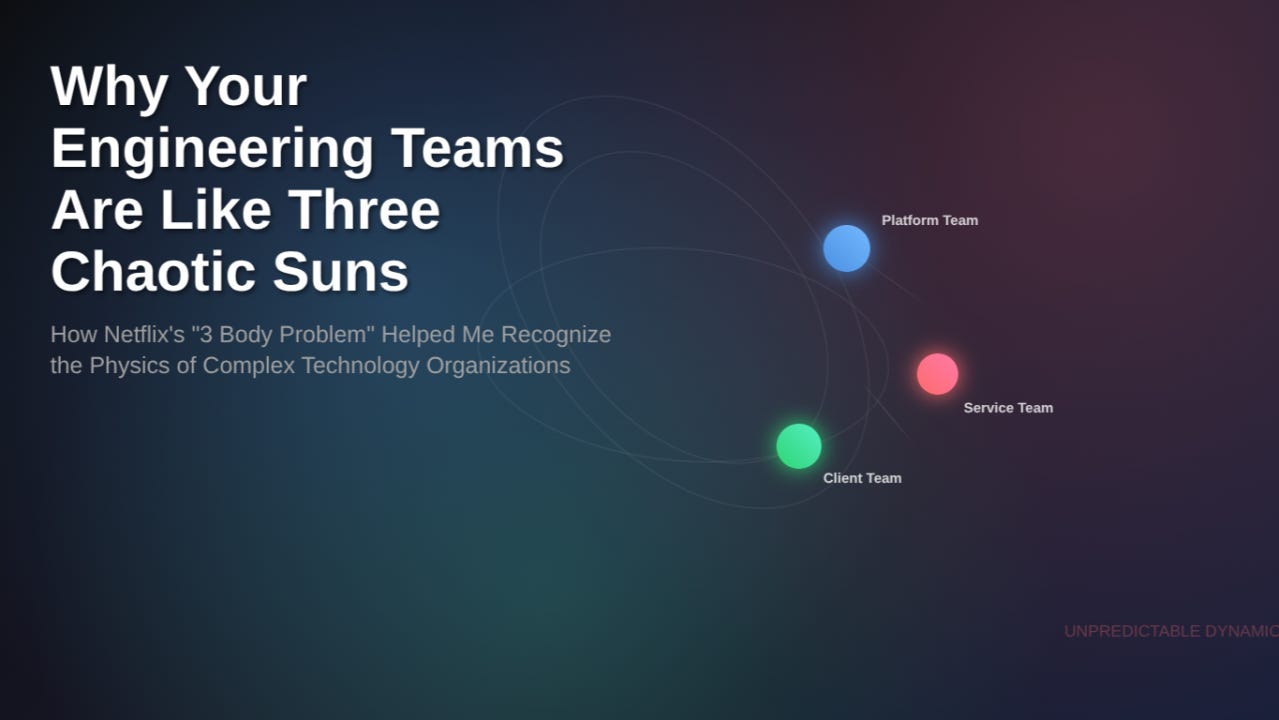
I was watching Netflix’s “3 Body Problem” late one evening when something clicked. As the characters struggled to predict the chaotic dance of three suns, each gravitationally pulling the others into increasingly erratic orbits, I couldn’t help but think about similarities to software engineering. Replace those celestial bodies with engineering teams, and suddenly the show felt less like science fiction and more like a documentary about enterprise software development.
In physics, the three-body problem describes how three gravitationally bound objects create chaotic, unpredictable dynamics despite following deterministic laws. Small changes cascade into dramatically different outcomes, making long-term prediction nearly impossible. This same phenomenon plagues large technology organizations where interdependent teams and applications create similar chaotic feedback loops.
When three or more engineering teams depend on each other’s work, they exhibit the same problematic dynamics: Team A changes an API affecting Team B’s timeline, delaying Team C’s integration, forcing Team A to work around missing functionality. Teams oscillate between priorities, never reaching stable equilibrium. The combined system behavior becomes far more complex than any individual team’s work would suggest, with small technical decisions rippling unpredictably throughout the organization.
Understanding this as a fundamental systems problem—rather than a coordination failure—opens up sophisticated management approaches that acknowledge the inherent tensions while designing for dynamic stability.
The Stabilizing Forces: Roles and Their Paradoxes
Traditional solutions attempt to impose stability through three key roles, each carrying inherent risks:
Platform Teams transform chaotic three-body problems into manageable two-body relationships by providing stable interfaces that teams can orbit around. However, platforms inevitably calcify over time, becoming gravitational monopolies that prevent evolution. Teams become dependent, innovation slows, and the platform becomes a bottleneck for meaningful change.
Technical Program Managers (TPMs) act as coordination layers, predicting and managing orbital mechanics between teams. They create communication channels and spot potential collision courses. However, when TPMs drift from coordination into solution-making, they ironically increase coupling by becoming dense gravitational centers that everything must revolve around.
Architecture Functions provide the fundamental “laws” governing how teams interact, reducing coupling through clear interfaces and predictable interaction patterns. Yet architects typically optimize for long-term stable states while organizations need to ship incrementally, creating a time horizon mismatch between perfect future design and immediate business value.
The challenge is that these stabilizing forces are essential but carry risks of creating the rigidity and over-coupling they’re meant to prevent.
Dynamic Stability Through Designed Evolution
The solution lies in designing systems that acknowledge these tensions explicitly rather than hoping they’ll resolve naturally. This requires three strategic approaches:
Platform Evolution Through Controlled Competition
Rather than treating platforms as permanent infrastructure, create forcing functions for evolution through planned “standardize and diverge” cycles. Allow limited adoption constraints in small lines of business where competing solutions can emerge. This internal competition creates Darwinian pressure—when new platforms deliver better outcomes in constrained environments, original platforms face existential pressure to innovate, adapt, or risk obsolescence.
The original platform must genuinely improve rather than incrementally enhance because it’s competing for internal market share. Sometimes divergent solutions discover fundamentally better approaches that should be absorbed back into the main platform. This creates natural evolution pressure while containing risk through limited blast radius.
Crisp Role Definition and Dual-Layer Architecture
TPMs must maintain precise boundaries between coordination and solution-making to prevent the drift toward over-coupling. Their role is to guide orbits, not pull bodies toward a gravitational center.
Architecture functions require intentional dual-layer investment: domain architects who understand local gravitational fields deeply, plus cross-domain architects who see system-wide dynamics. Critically, architects need explicit permission to contribute to short-term value even when it diverges from long-term vision, with explicit commitment to addressing the long-term implications later.
Incentive Alignment for System-Wide Thinking
Senior engineers often optimize locally within their domain expertise without understanding broader system impacts. Combat this through incentives that reward cross-domain understanding and system-wide optimization. Measure and reward engineers not just for their local domain performance but for their contribution to reducing system-wide coupling and complexity.
Create rotation programs that expose domain experts to other parts of the system. Establish “complexity budgets” that teams must manage collectively, making the hidden costs of local optimization visible at the system level.
Implementation Framework
Establish Evolution Cycles: Build explicit rhythms for platform standardization and planned divergence. Create protected spaces for experimentation within constrained environments while maintaining accountability for system-wide impacts.
Define Gravitational Rules: Make the interaction patterns between teams explicit through clear interface contracts, communication protocols, and decision-making boundaries. Document not just what teams do, but how their decisions affect other teams.
Measure System Health: Track leading indicators of three-body chaos: increasing coordination overhead, lengthening decision cycles, and growing technical debt that spans multiple teams. Create dashboards that make system-wide coupling visible to leadership.
Design Constructive Tension: Don’t eliminate the forces that create instability—channel them productively. Internal competition, time horizon tensions, and role boundaries create useful pressure that drives evolution when properly managed.
The three-body problem in technology organizations isn’t a bug to be fixed but a fundamental characteristic of complex systems that must be actively managed. Success comes not from eliminating chaos but from designing the type of productive instability that drives continuous evolution while maintaining enough stability to deliver value. Organizations that master this balance create technology systems that remain adaptive and resilient over time, rather than optimizing for today’s requirements at the expense of tomorrow’s possibilities.
Key Takeaways
For Technology Leaders:
- Complex interdependencies between teams create inherent chaos that cannot be eliminated, only channeled productively
- Traditional stabilizing forces (platforms, TPMs, architecture) are essential but carry risks of creating the rigidity they’re meant to prevent
- Internal competition and controlled divergence drive evolution better than top-down mandates
- System-wide thinking requires intentional design—it won’t emerge naturally from local optimization
For Individual Contributors:
- Domain expertise without cross-system understanding creates unintended complexity for other teams
- Small technical decisions in interconnected systems can have disproportionate downstream impacts
- Contributing to long-term system health often requires accepting short-term inefficiencies in your local domain
- Understanding your team’s “gravitational effect” on others is as important as optimizing your own work
---
What patterns have you observed in your own organization that mirror the three-body problem? Have you discovered other approaches to managing complex interdependencies that create both stability and adaptability? I’d love to hear about your experiences with platform evolution, cross-team dynamics, or novel organizational structures that address these challenges. Share your thoughts and let’s continue building this framework together.