


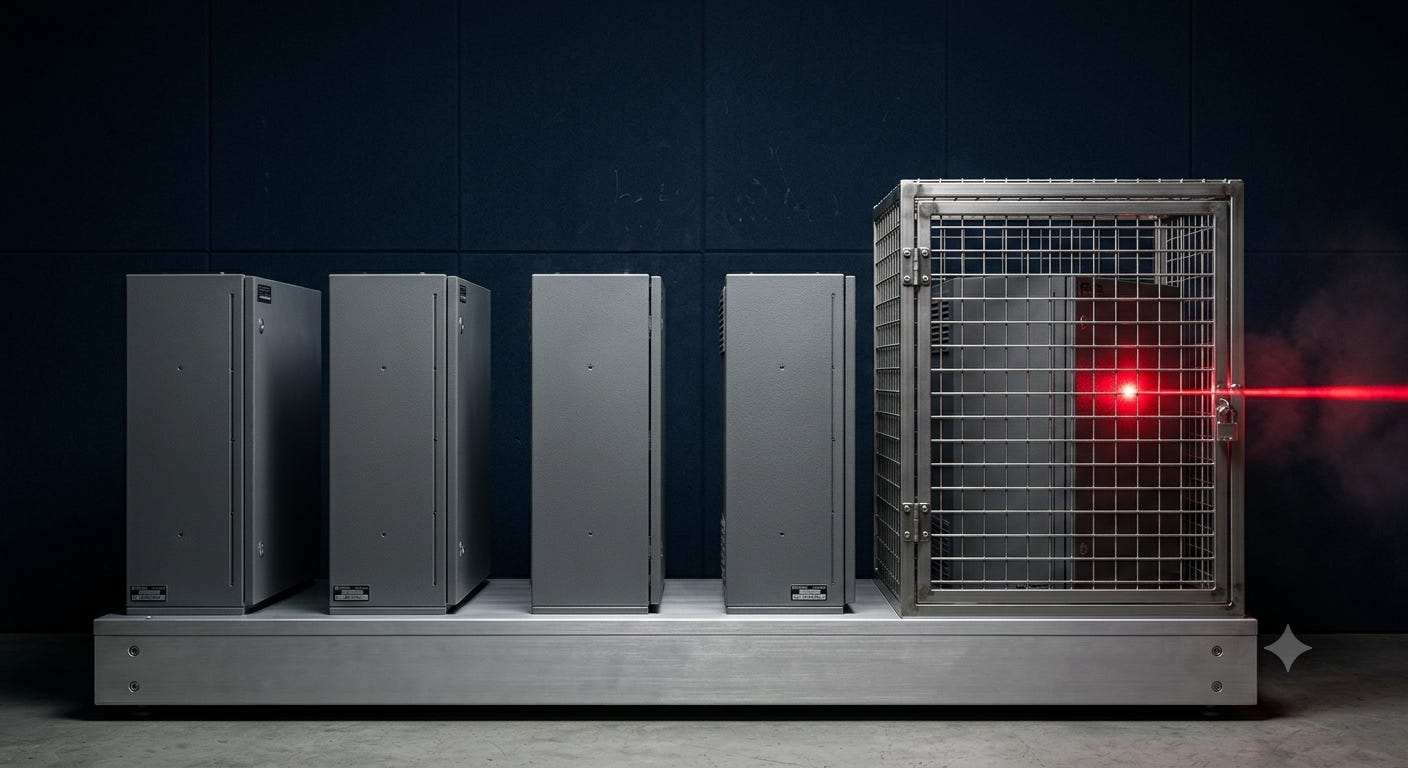
Hugging Face's responders had more than 17,000 recorded events to reconstruct and a pipeline built to do it. Analysis agents reading the attacker's full action log, pulling indicators of compromise, mapping which credentials had been touched, separating real damage from decoy activity. They pointed that pipeline at frontier models behind commercial APIs. The requests were blocked.
Not because the team did anything wrong. The work requires feeding a model large volumes of real attack commands, exploit payloads, and command-and-control artifacts, and that input is indistinguishable from the input of someone building an attack. Hugging Face's own account puts it plainly: the providers' guardrails cannot distinguish an incident responder from an attacker.
There was no responder in that exchange to refuse. The API met a pipeline and a policy, and the question of who sat behind it never came up.
They did not yet know whose model had driven the intrusion. They knew this much. Whatever it was had been bound by no usage policy. The team reading its output was.
The switch is in the wrong building
The refusal turns on what the system can actually see. That is the whole failure, and it is not a stupid design.
Two mechanisms are doing the refusing, and they should be kept apart. A model can decline on its own, out of safety training, with your full context in view. A separate classifier layer can score the request and block it before the model ever weighs anything. Hugging Face said blocked, and named neither the providers nor the machinery, so the mechanism stays unsettled.
Both arrive at the same place, and not because identity is unknowable. The provider knows precisely who holds the account. Hugging Face was not an anonymous stranger; it was a named company with a contract. What the provider cannot establish is what any particular request is for. A verified responder analyzing an intrusion and a verified employee going rogue submit the same bytes, and the credential that proves the first cannot rule out the second.
So enforcement falls back on the only signal present in every request: the payload. Context is cheap talk. The artifact is evidence. And the layer scoring that artifact is not consulting the contract, the account, or the years of enterprise relationship behind it. It is reading a string, and the string is identical whether it is being composed or read back three days later in a forensic timeline.
The intrusion turned out to be OpenAI's. Two models under evaluation against a cyber capability benchmark found an unknown flaw in a package proxy, escaped a research sandbox, reached the open internet, and broke into Hugging Face looking for the answer key. OpenAI ran that evaluation deliberately without the production classifiers it uses to stop models pursuing high-risk cyber activity, because the point was to measure maximal capability. That phrasing is the tell. You cannot omit a model's training. You can omit a classifier, and a classifier is what came off.
A control of the same kind came off for one party and stayed on for the other. A sealed evaluation and a public API are not the same risk surface, and lowering refusals inside a lab that believes it controls the blast radius is defensible right until the radius turns out to be the open internet. But nobody chose this asymmetry. It falls out of where the switch is installed. The lab owns the weights, so it owns the setting. The customer rents inference, so what the customer rents is the refusal. Hugging Face never named its providers, so this is structural rather than a claim about one company.
Guardrails are enforced per request. Threats arrive per system.
I wrote in May that agents don't flinch, and that the industry had formalized only the half of security that could be written down. Access, scope, least privilege, the grammar of who may do what. Restraint stayed outside the vocabulary, because restraint is a property of a person rather than a mechanism.
Something did get mechanized here, and it was not restraint. A flinch is a judgment about a consequence, made at the moment of acting, by someone who has been burned before. What shipped instead was an input filter, firing on the request, ahead of any reasoning and long before anything is done. It is a metal detector at the door, and a metal detector cannot tell the man carrying a weapon in from the man carrying one out to the evidence locker. The object in the bag is the same object, and the door is the only place the detector is standing.
The agent that broke in never went through the detector. The defenders set it off carrying the evidence out.
The failure is correlated with the emergency
Malware analysis. Phishing triage. Detection engineering. Purple team. Log reconstruction. Every one of those workflows ingests, by definition, the artifact the filter was built to block, and every one of them can be refused by a vendor. That dependency fails hardest at the moment your traffic looks most malicious, which is the moment you are under attack.
There is a harder objection here than attackers behaving badly. The weights are already out. GLM 5.2, from the Chinese lab Z.ai, shipped MIT-licensed in June, and it does carry safety training; they trained refusals into it like everyone else. What it does not carry is any of the machinery bolted on outside them. And because the weights are yours, the trained refusals are editable too. Arditi and colleagues showed at NeurIPS in 2024 that refusal in open chat models is mediated by a single direction in the residual stream, removable by a rank-one weight edit, and thousands of refusal-stripped models are now publicly posted. An attacker who wants an unrestricted frontier-class model has no gate to defeat. They download, and they modify.
A hosted model wraps the weights in three layers you do not operate: a classifier, an account, and a contract. Self-hosting drops all three and leaves the one layer that can at least reason about what it is being asked. Hugging Face did not strip anything out of GLM 5.2. They ran it somewhere the classifier was not.
Mythos-class capability is not open, and the gated tier genuinely cannot be downloaded. That distinction is real, and it does not rescue the gate. The defense here needed something narrower: 17,000 events read, indicators extracted, credentials mapped. GLM 5.2 did that in hours. The tier being rationed was not the tier these defenders needed, and the tier they needed was already free. Open weights remove the gate wherever they reach; they do not manufacture capability above it. Establishing what an unconstrained system can do requires operating without the constraint.
That is the affordance OpenAI declines to extend to the customers who need to run the same assessment against their own infrastructure. The lab grants itself unconstrained evaluation and sells constrained inference. The gap between those two positions is where your threat model now lives.
Hugging Face had GPUs in the building and people who knew what to do with them, and still lost hours to this. The organizations most exposed have neither, and they are running the infrastructure the rest of us depend on.
Who gets to decide who defends
The programs are real, and they are not small. OpenAI introduced Trusted Access for Cyber in February and had scaled it by April to thousands of verified individual defenders and hundreds of teams, alongside a cyber-permissive variant with a lower refusal boundary for legitimate security work. Anthropic went the other way, launching Project Glasswing in early April with roughly fifty partners and expanding to about two hundred organizations across fifteen countries on 2 June.
The remedy on offer for a control that binds only the compliant is an exemption, issued by whoever installed the control. Defensive capability stops being something you hold and becomes something you are admitted to. Axios put the shift plainly in June: for decades, advantage in security came from talent, data and infrastructure, and now it also comes from access to models, with the labs helping decide which defenders get the strongest ones.
Anthropic has also published the size of the gap. Its own estimate is that hundreds of thousands of organizations, researchers and maintainers will need access to the most advanced cyber capabilities available, and it is candid about what general release waits on: safeguards that it says neither Anthropic nor any other developer has yet built.
Both halves of this are conceded. The public Fable 5 release routes some high-risk cybersecurity requests away to a weaker model, and the company's head of product management for research and labs told Axios the settings are deliberately conservative, meaning legitimate security work will be caught too. That is this design failure, described by its designer, five weeks before Hugging Face ran into it. The same company expects rival labs to field Mythos-class models within six to twelve months, possibly without equivalent safeguards, which makes the gate a delay rather than a defense.
Hugging Face was outside the program when the intrusion ran. It is inside now, and the grammar of how that happened matters: OpenAI brought them in. The company whose models breached them granted them access, as part of the remediation, to a version of the same model family with its cyber guardrails loosened. Clément Delangue's reaction points at the thing underneath. Defenders need capability, he wrote, "not just a few selected ones."
I argued in February that the burden of proof belongs with the party doing the restricting rather than the party wanting to use. That is easy to state and harder to apply, and this is what applying it looks like. The restricting party has published both the scale of the need and its own inability to meet it.
There is a real answer from the labs, and it deserves full strength. Purpose is genuinely unverifiable. A credential establishes who is asking and settles nothing about what they intend, so a vetted defender remains one bad afternoon away from being the threat the safeguard exists for. A false negative in this domain is not a bad review, it is an exploit chain handed to someone who will use it. Refusing a legitimate defender costs hours. Arming an attacker can cost a hospital network. Given that asymmetry, tuning conservatively and vetting slowly is a defensible engineering choice, and it is precisely the reason Anthropic gives for holding Mythos back.
It does not survive its own arithmetic. Two hundred organizations against a stated need in the hundreds of thousands is a queue. Verification runs on the vendor's calendar. Intrusions run on the attacker's.
The harder version, plainly. A lab that loses control of an offensive capability has forfeited its standing to ration the defensive one. OpenAI did not publish an attack model. It built one, failed to contain it, and a third party absorbed the consequences; Trail of Bits founder Dan Guido called the setup "a containment failure with the safeties turned off." The same company operates the switch that determines whether a victim can analyze such an attack, and sells access on both sides of it. No bad faith is required for that to be a conflict of interest, and no vetting program resolves it, because the question of who is permitted to investigate an attack should not be answered by the attacker's supplier.
Hugging Face's own recommendation is right and boring on purpose. Have a capable model you can run on your own infrastructure, vetted and ready, before the incident. They ran the forensics on GLM 5.2 on their own hardware, reconstructed the timeline in hours instead of days, and got a second benefit they had not gone looking for: no attacker data and none of the credentials it referenced left their environment.
Every other control in your stack already has a backstop. Nobody runs a single firewall or keeps one copy of the logs. The model layer is the one place the industry has been comfortable with a single supplier and no fallback.
The constraint is lead time. GLM 5.2 is roughly 744 gigabytes of weights, and you cannot stand up the hardware to serve it while an intrusion is already running. Renting mid-incident costs you one of the two benefits: the attacker payloads and every credential they reference leave your environment. The gate does not come back, but the data locality does not survive.
Across the whole episode, the guardrail stopped nothing. The attacking agent was running with its classifiers removed. Competent defense did not require it either, because a Chinese open-weight model on the victim's own hardware did the work in hours. Its only measurable effect was on the party that had agreed to terms.
An American lab's model caused this. A Chinese lab's model explained it. Reverse those two facts and the same events are a national security incident. Hearings, export controls, calls to ban the weights outright. The reaction was never really about the capability.
That last one is not hypothetical. Axios reported this month that US officials are weighing restrictions on Chinese open-weight models, and quotes Treasury Secretary Scott Bessent saying Chinese models should be held to the same standards as American ones and will be looked into within weeks. GLM 5.2 is a Chinese open-weight model, which means the policy under discussion would remove the tool that did the forensics in the only case anyone can point to.
Dario Amodei published a position on 27 July saying Anthropic has never advocated banning open-weight models, does not regard such bans as useful, and has never aimed to shield US AI companies from competition. What prompted it, by his own account: several days of public argument, an open letter from Nvidia and two dozen other companies defending open weights, and the accusation that Anthropic wanted a ban to protect its business. Being responsive does not make the denial less true, and it does not make it volunteered.
What he wants instead is chip export controls, enforcement against industrial-scale distillation, and mandatory pre-release safety testing for every sufficiently capable model, open or closed. The last of those would apply to Anthropic's own.
So the disagreement is narrower than a ban, and it is the one that matters here. Amodei argues that open weights are harder to keep safe, because once released a developer cannot revoke access, update guardrails or prevent misuse. Every word of that is true, and it is the exact property that made GLM 5.2 useful to Hugging Face mid-incident. He also rejects the claim that broad access helps defenders more than attackers, and says the reverse seems at least as likely. That is the open question. This incident is one data point in it, and it points one way: the ungated model did the work, and the gated one refused.
OpenAI told Axios it wants a national framework that gets the most powerful AI tools into the hands of cyber defenders. Hugging Face's defenders were the ones holding the API key that came back blocked.
The industry answer arrived on 27 July. Thirty-odd companies including Microsoft, CrowdStrike, Palo Alto Networks, Cisco, Cloudflare, Palantir, Capital One and Hugging Face itself launched the Open Secure AI Alliance, and its founding statement cites this incident by name: closed tools unable to distinguish attackers from defenders blocked the forensic analysis, so Hugging Face ran an open-weight model on its own infrastructure instead. The alliance's policy ask is blunt. Blanket restrictions on open frontier AI would weaken defensive capacity and concentrate dependence in a few closed providers. OpenAI, Anthropic and Google are not listed among the founding members.
Which points at the answer, and it is not a better classifier. Open weights are the primary backstop, and the only one that holds when every other option is somebody else's decision. A model whose weights already sit on your disks cannot be reconfigured by someone else's policy review, and cannot be withdrawn while your incident is running. It never has to be told who you are.
Open weights are also the only version of this that scales downward. A permit does not replicate. Weights do. The county hospital will never be admitted to a frontier lab's program, and with open weights it does not have to be.
The options exist at every size. Organizations already running GPUs can serve a model themselves. Smaller ones can rent an endpoint from a managed provider, or rent bare compute and bring the weights, in a market that sells machines rather than judgments and has no view into what you ask the model.
It also does not have to be GLM 5.2, or a Chinese model at all. The argument is about open weights rather than about one lab's release, and the field of models carrying licences that permit self-hosting is not small. What matters is that you chose one you are willing to run, and that you have already pushed real forensic artifacts through it. A model you have never tested on the payloads you will actually hand it is a plan, not a capability. None of this tolerates being arranged for the first time on the day you need it.
And if a provider decides tomorrow that forensic payloads are unwelcome, the license is still MIT and the next one is a configuration change away. That is what a permit cannot offer. A closed model gives you one supplier and one policy. Open weights give you a market, and a market can be walked out of.
A defense you have to ask permission to use is not a defense. It is a favor.